

SWRO membrane cleaning: When and How to Perform CIP
In a seawater reverse osmosis (SWRO) system, membrane performance does not remain constant throughout the operating life of the plant. Even with proper pretreatment, membrane surfaces can gradually accumulate organic matter, suspended solids, biological deposits, mineral scale, or other contaminants. As these deposits build up, permeate flow may decrease, feed pressure may increase, and differential pressure across the membrane system can become higher.
When these changes become significant, chemical cleaning, commonly called Clean-in-Place (CIP), may be required.
CIP is not simply a matter of circulating chemicals through the RO membranes. The timing, cleaning sequence, chemical selection, pH, temperature, flow rate, pressure, and rinsing procedure all affect the result. Cleaning too early can increase chemical consumption and membrane exposure, while cleaning too late can make deposits more difficult to remove.
For operators of Seawater Desalination Equipment, the practical goal is to identify performance changes early and use CIP when operating data indicates that membrane cleaning is justified.
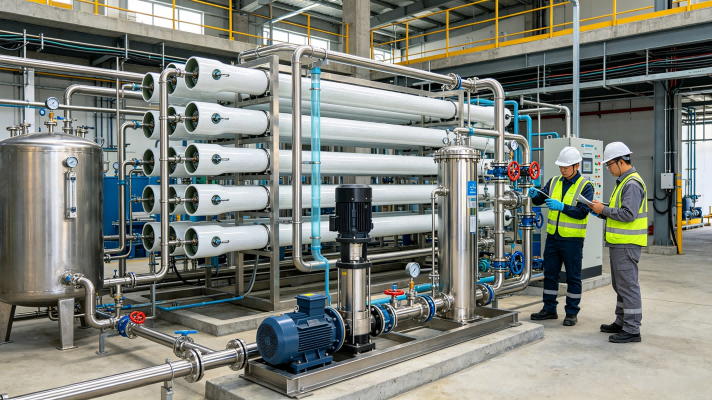
Clean-in-Place is a maintenance procedure that allows RO Membrane Elements to be chemically cleaned without removing them from their pressure vessels.
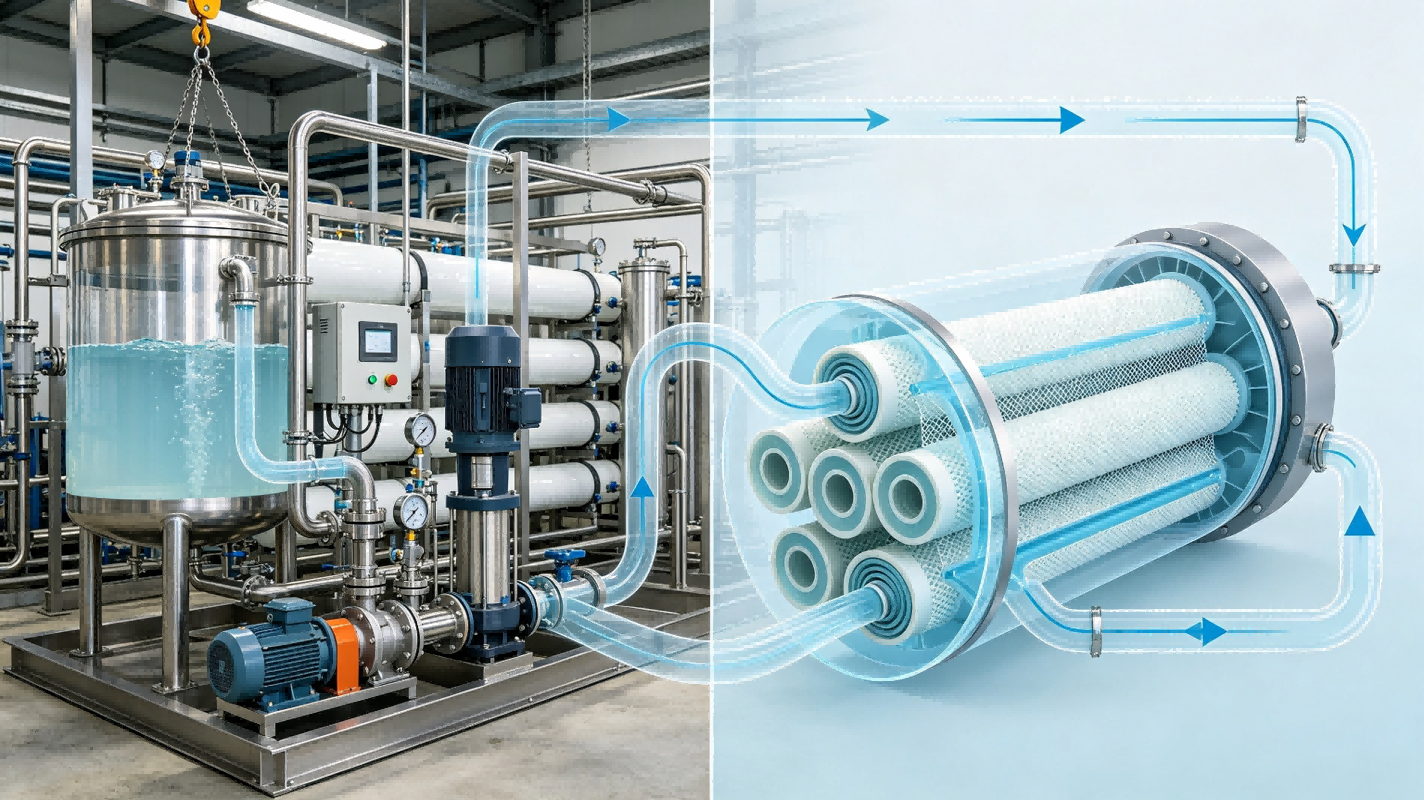
During a typical CIP operation, a cleaning solution is prepared in a dedicated cleaning tank and circulated through the RO pressure vessels using a cleaning pump. The solution contacts the membrane surfaces and feed channels, helping dissolve, loosen, or remove accumulated contaminants.
A typical CIP system may include:
Cleaning tank
CIP circulation pump
Cartridge filter
Chemical dosing or mixing system
Valves and piping
Pressure and temperature instruments
Return line to the cleaning tank
The cleaning system is normally separated from the high-pressure operating circuit. This allows the membranes to be cleaned under controlled low-pressure conditions rather than normal SWRO operating pressure.
The exact CIP configuration depends on the number of pressure vessels, membrane arrangement, system capacity, membrane manufacturer requirements, and the type of contamination expected.
Seawater contains a wide range of dissolved and suspended substances. Pretreatment removes much of the material that could damage or foul the RO membranes, but it cannot eliminate every contaminant.
Several types of deposits can affect SWRO membranes.
If pretreatment is insufficient, fine particles can enter the RO system and accumulate inside the feed channels.
This can increase hydraulic resistance and contribute to a rise in differential pressure.
Natural seawater contains organic compounds and microorganisms. Some organic material can attach to the membrane surface and provide a foundation for further fouling.
Organic fouling can gradually reduce permeate production and increase cleaning requirements.
Microorganisms can grow in suitable conditions and form biofilms on membrane surfaces and feed spacers.
Biofouling can be particularly difficult to control because the deposits may contain extracellular polymeric substances that make the fouling layer relatively resistant to simple flushing.
Concentrated brine conditions inside the RO system can increase the risk of precipitation of sparingly soluble salts.
Scaling can reduce membrane permeability and restrict flow channels. Depending on the water chemistry, different mineral deposits may require different cleaning approaches.
Iron, manganese, corrosion products, and other inorganic contaminants may also accumulate on membranes.
Identifying the likely deposit before selecting a cleaning chemical is important because a chemical effective against one type of fouling may have limited effectiveness against another.
One of the most important questions in RO maintenance is not simply how to clean the membrane, but when to clean it.
Operators should normally evaluate membrane performance using normalized operating data rather than relying only on instantaneous flow or pressure readings.
Typical indicators include:
Declining normalized permeate flow
Increasing normalized salt passage
Increasing feed pressure requirement
Increasing differential pressure
Changes in permeate conductivity
Abnormal pressure loss across membrane stages
Repeated operating deviations after pretreatment changes
A reduction in permeate flow does not automatically mean that the membrane needs CIP. seawater temperature, feed salinity, recovery, pressure, and other operating conditions can also affect production.
For this reason, trend analysis is more useful than looking at a single measurement.
For example, if permeate flow decreases during a period of colder seawater, the change may partly result from higher water viscosity. If the decline continues after temperature effects are accounted for, fouling or scaling becomes a more important possibility.
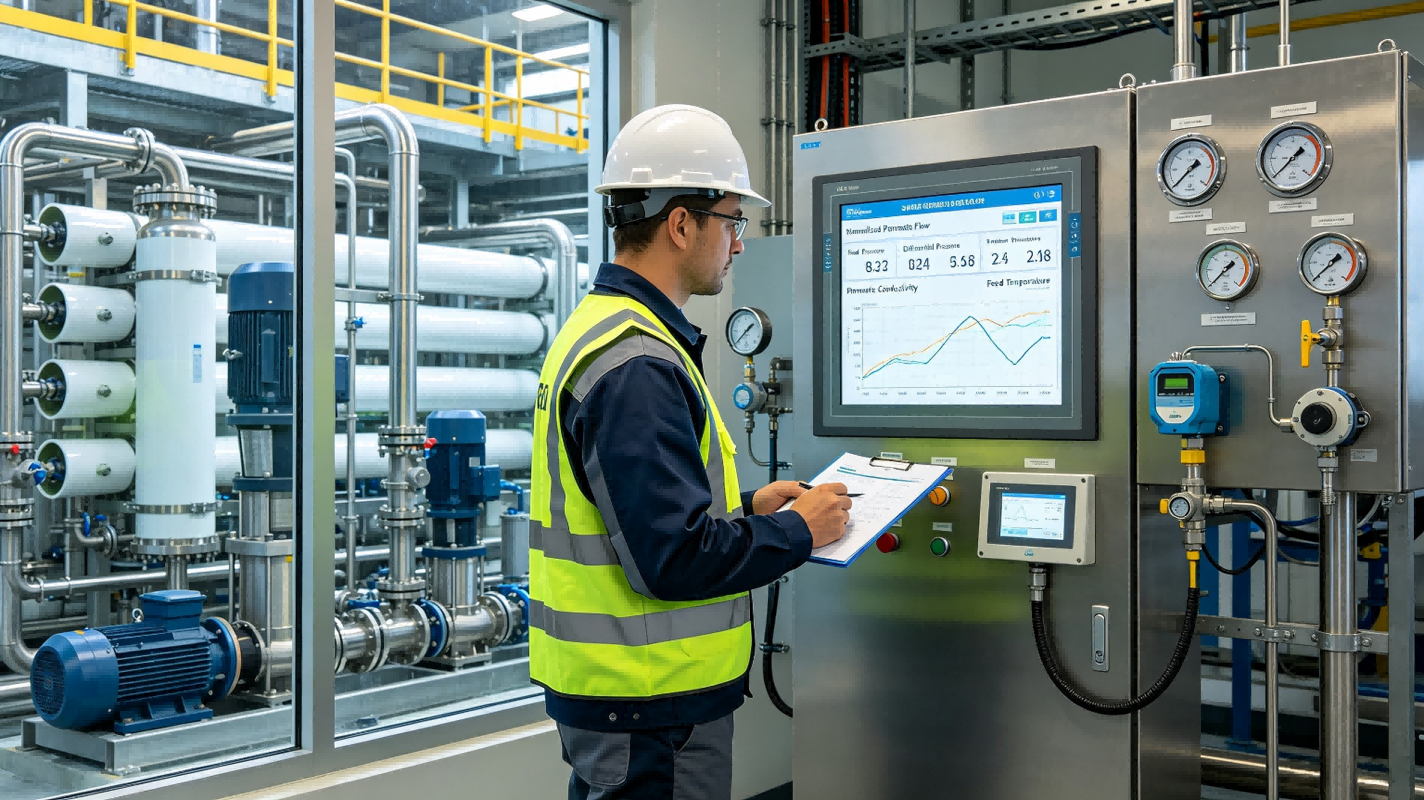
Raw permeate flow can be misleading because SWRO operating conditions constantly change.
A membrane system operating in colder seawater may produce less permeate than the same system operating in warmer seawater, even when the membrane condition has not changed.
Normalization adjusts operating data for important variables such as:
Feed temperature
Feed pressure
Feed salinity
Permeate pressure
Recovery
Normalized permeate flow can therefore provide a more useful indication of membrane condition.
Operators can establish a baseline after commissioning or after a successful cleaning and compare later operating data against that baseline.
This creates a practical maintenance history.
Instead of waiting until the system experiences a severe pressure increase or substantial production loss, operators can identify a gradual performance trend and plan CIP at a more appropriate time.
A typical CIP procedure includes several stages. The exact sequence and chemical conditions must follow the membrane manufacturer's cleaning requirements and the characteristics of the actual fouling.
Before starting CIP, operating data should be reviewed.
The operator should check feed pressure, permeate flow, differential pressure, conductivity, recovery, temperature, and recent pretreatment performance.
It is also useful to determine whether the problem is actually membrane fouling.
For example, a malfunctioning pressure sensor, blocked cartridge filter, feed pump problem, or pretreatment failure can create abnormal operating conditions that may be incorrectly attributed to membrane fouling.
The RO pressure vessels are normally flushed with suitable low-pressure water before chemical cleaning.
The purpose is to remove loose deposits and replace the seawater or concentrated brine remaining inside the system.
Flushing also helps reduce the initial chemical load on the cleaning solution.
The quality of water used for flushing is important. Depending on the system design and membrane manufacturer's requirements, permeate or another suitable low-salt water source may be used.
The cleaning solution is prepared in the CIP tank.
Chemical selection depends on the type of deposit.
Acidic cleaning solutions are commonly associated with inorganic scale and certain mineral deposits, while alkaline cleaning solutions may be used for organic deposits, biological material, and some particulate fouling.
However, chemical compatibility must always be checked before use.
The wrong chemical, excessive concentration, unsuitable pH, or excessive temperature can damage the membrane or reduce its useful operating life.
The cleaning solution is introduced into the RO pressure vessels at controlled low flow.
Initially, the cleaning solution leaving the vessels may contain a significant amount of seawater and contaminants.
It may therefore be returned to drain or handled according to the cleaning procedure rather than immediately recirculated.
This stage allows the original process water to be displaced by the cleaning solution.
After the cleaning solution has filled the relevant flow path, it is circulated through the membrane vessels.
The cleaning solution moves through the feed channels and returns to the CIP tank.
Circulation helps maintain contact between the cleaning solution and the deposits.
Flow should be controlled carefully. CIP is generally performed at much lower pressure than normal RO operation because the purpose is to move cleaning solution through the membrane channels rather than produce permeate.
The cleaning solution should also be monitored for temperature, pH, and other relevant parameters during circulation.
Some deposits respond better when the cleaning solution remains in contact with the membrane for a period of time.
A soaking stage can therefore be incorporated into the cleaning sequence.
The appropriate soaking time depends on membrane type, chemical solution, contamination, temperature, and manufacturer recommendations.
Longer cleaning time does not automatically mean better cleaning. Prolonged chemical exposure can increase membrane stress without providing proportional benefits.
After chemical circulation is completed, the system must be thoroughly rinsed.
The objective is to remove residual cleaning chemicals and loosened contaminants from the pressure vessels, membrane channels, and associated piping.
Rinsing should continue until the relevant water-quality and chemical indicators meet the required conditions for returning the system to service.
Insufficient rinsing can cause chemical carryover and may affect subsequent membrane performance.
Chemical selection is one of the most sensitive parts of membrane cleaning.
There is no universal cleaning chemical that is suitable for every SWRO fouling problem.
The cleaning strategy should consider:
Type of foulant
Membrane material
Membrane manufacturer's chemical limits
Cleaning pH
Cleaning temperature
Chemical concentration
Contact time
Flow conditions
Disposal requirements
For mineral scale, an appropriately selected acidic cleaner may be considered.
For organic or biological deposits, an alkaline cleaning step may be more appropriate.
In some cases, a sequence of different cleaning solutions is used. For example, an alkaline cleaning stage may be followed by an acidic cleaning stage when the fouling layer contains multiple types of deposits.
The sequence should be determined according to the actual contamination and membrane compatibility rather than following a fixed recipe for every installation.
Chemical effectiveness is strongly affected by pH and temperature.
Increasing temperature can accelerate certain chemical reactions and improve cleaning performance, but membranes have specified temperature limits. Exceeding those limits can cause irreversible membrane damage.
Similarly, membrane manufacturers specify allowable pH ranges for cleaning.
A solution outside the recommended range can affect membrane materials, adhesives, seals, or other components.
For this reason, CIP operators should continuously monitor cleaning solution temperature and pH rather than preparing the solution and leaving the system unattended.
An important practical point is that CIP should not be treated as normal RO operation.
During production, high-pressure seawater is used to overcome osmotic pressure and drive water through the membrane.
During CIP, the objective is different.
The cleaning solution needs sufficient flow to contact and sweep the membrane feed channels, but excessive pressure should be avoided.
High CIP pressure can push contaminants deeper into the membrane structure or cause unnecessary permeate production. It can also make chemical cleaning less controllable.
A properly designed CIP system therefore provides controlled circulation rather than simply reproducing the operating pressure of the SWRO system.
Operating data can provide useful clues.
If differential pressure gradually increases while permeate flow decreases, deposits inside the feed channels may be contributing to hydraulic resistance.
If normalized permeate flow decreases but differential pressure changes only moderately, membrane surface fouling or scaling may be involved.
If salt passage increases significantly, membrane condition or integrity should also be investigated rather than assuming that fouling is the only problem.
These observations are not a substitute for water analysis or membrane inspection, but they can help guide troubleshooting.
In larger desalination plants, historical operating data, feedwater analysis, autopsy results, and cleaning-solution observations can be combined to identify recurring fouling mechanisms.
Frequent membrane cleaning is often a sign that the entire treatment process needs to be reviewed.
Pretreatment has a direct influence on RO membrane operating life.
Depending on seawater quality and system design, pretreatment may include:
Intake screening
Coagulation and clarification
Media filtration
Ultrafiltration
Cartridge filtration
Chemical dosing
pH adjustment
Antiscalant dosing
The appropriate configuration depends on the source water and project requirements.
If suspended solids or biological material repeatedly enter the SWRO system, simply increasing the frequency of CIP may treat the symptom without solving the underlying problem.
A better approach is to examine pretreatment performance, cartridge filter condition, feedwater quality, intake conditions, and chemical dosing together with RO operating data.
A successful cleaning should be followed by performance verification.
The system can be restarted under controlled conditions, and operators can record:
Feed pressure
Permeate flow
Concentrate flow
Permeate conductivity
Differential pressure
Feed temperature
Feed salinity
Recovery
These values should then be compared with the pre-cleaning condition and the established baseline.
A significant recovery in normalized permeate flow or a reduction in differential pressure can indicate that the cleaning removed a substantial amount of accumulated material.
However, CIP does not always restore a membrane to its original condition.
Membrane aging, irreversible fouling, oxidation, mechanical damage, and long-term chemical exposure can cause permanent performance loss.
This is why cleaning should be considered a maintenance procedure, not a way to reverse every form of membrane degradation.
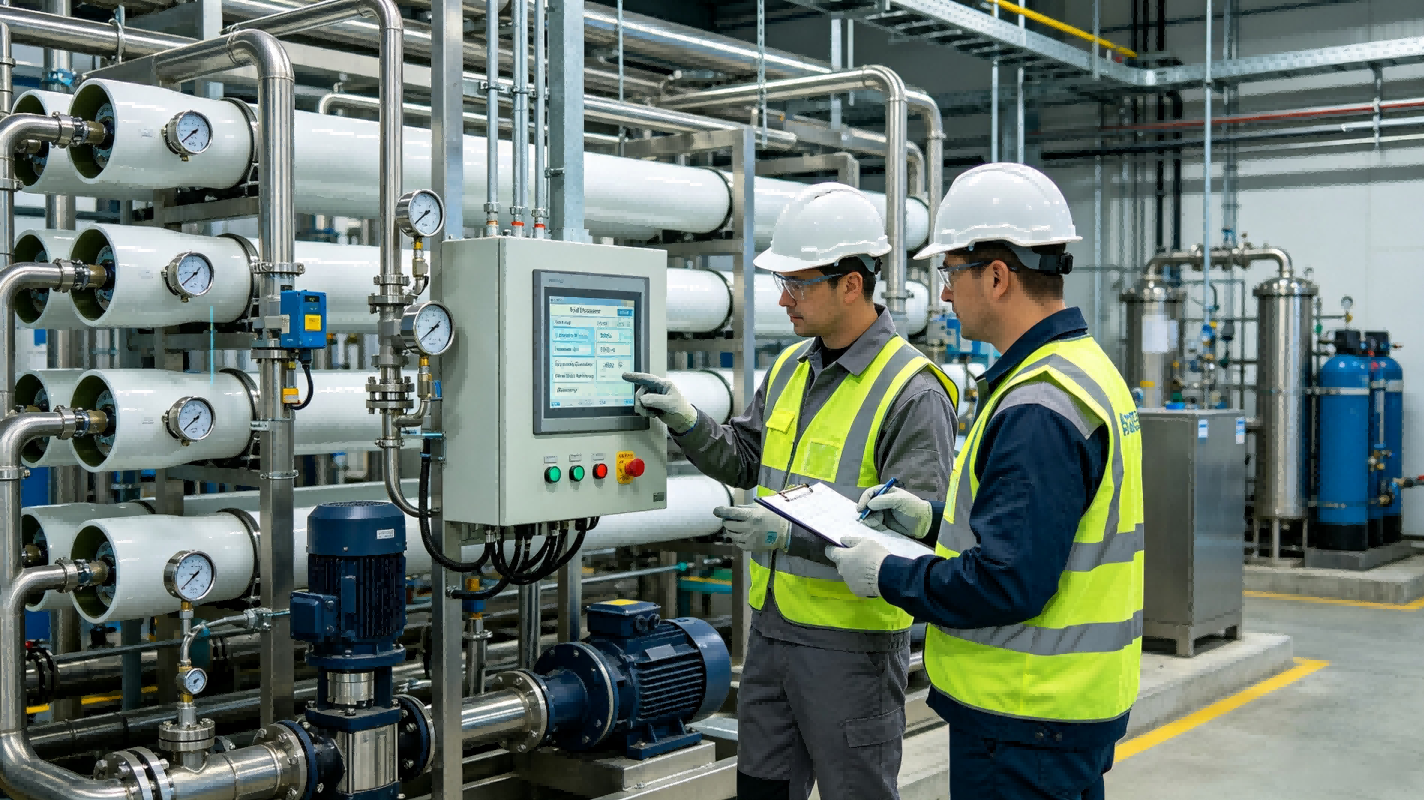
The best CIP program is not necessarily the one with the most frequent cleaning.
Good operation aims to keep membranes clean enough to maintain stable performance while avoiding unnecessary chemical exposure.
Several practices can help:
Monitor turbidity, SDI or other relevant feedwater indicators, cartridge filter differential pressure, and pretreatment operating conditions.
Record normalized permeate flow, salt passage, pressure, and differential pressure over time.
Changes in recovery can affect concentration polarization and scaling conditions inside the membrane system.
Antiscalant and other pretreatment chemicals should be dosed according to feedwater conditions and the system design.
A gradual performance decline is generally easier to investigate than a severe decline after deposits have accumulated for a long period.
Each CIP event should be documented, including chemical type, concentration, pH, temperature, circulation time, pressure, flow, and performance before and after cleaning.
Over time, these records can help identify recurring fouling patterns.
CIP should be considered during the original design of Seawater Desalination equipment rather than added as an afterthought.
A practical SWRO system should provide appropriate connections for cleaning, flushing, isolation, chemical circulation, drainage, and monitoring.
The arrangement of RO pressure vessels should also allow the operator to isolate and clean appropriate sections when required.
Instrumentation is equally important. Reliable pressure, flow, conductivity, and temperature measurements provide the data needed to determine whether membrane performance is changing.
For larger projects, automated valves and a dedicated CIP skid can simplify cleaning procedures and improve repeatability.
For containerized or compact SWRO systems, the CIP arrangement needs to balance available space with maintenance requirements.
Chemical cleaning is only one part of SWRO membrane maintenance.
A complete maintenance strategy should include feedwater monitoring, pretreatment control, cartridge filter replacement, operating-pressure management, recovery control, membrane performance normalization, leak checks, and periodic inspection.
The objective is to keep the membrane system operating within its intended range for as long as practical.
When CIP is required, the cleaning process should be based on actual operating evidence and membrane compatibility rather than a fixed calendar schedule alone.
For seawater Desalination Equipment, this approach helps operators make maintenance decisions based on the condition of the membrane system.
SWRO membrane cleaning is a technical maintenance procedure that requires more than adding chemicals to a tank and circulating them through the RO vessels.
The first step is identifying whether membrane performance has genuinely declined and determining the likely cause. Normalized permeate flow, differential pressure, feed pressure, salt passage, conductivity, temperature, and other operating data can provide valuable evidence.
Once CIP is justified, the cleaning process should be controlled from initial flushing and chemical preparation through circulation, soaking, rinsing, and post-cleaning performance verification.
Chemical compatibility, pH, temperature, pressure, flow, and cleaning time all need to remain within appropriate limits.
For long-term SWRO operation, the most effective approach is usually a combination of reliable pretreatment, stable operating conditions, continuous performance monitoring, and well-controlled CIP when the membrane condition indicates that cleaning is needed.
This turns membrane cleaning from a reactive maintenance task into a planned part of seawater reverse osmosis system management.
เว็บไซต์นี้ใช้คุกกี้เพื่อให้แน่ใจว่าคุณได้รับประสบการณ์ที่ดีที่สุดบนเว็บไซต์ของเรา
 English
 Portugues
 Pусский
 Français
 العربية
 Indonesia
 Melayu
 Tiếng Việt
 中文
中文 қазақ
қазақ עִברִית
 မြန်မာ
 ພາສາລາວ
 Filipino
 o'zbek
 Кыргызча
 тоҷикӣ
 ខ្មែរ
ខ្មែរ Türkmenler



 โทรศัพท์
ความคิดเห็น
(0)